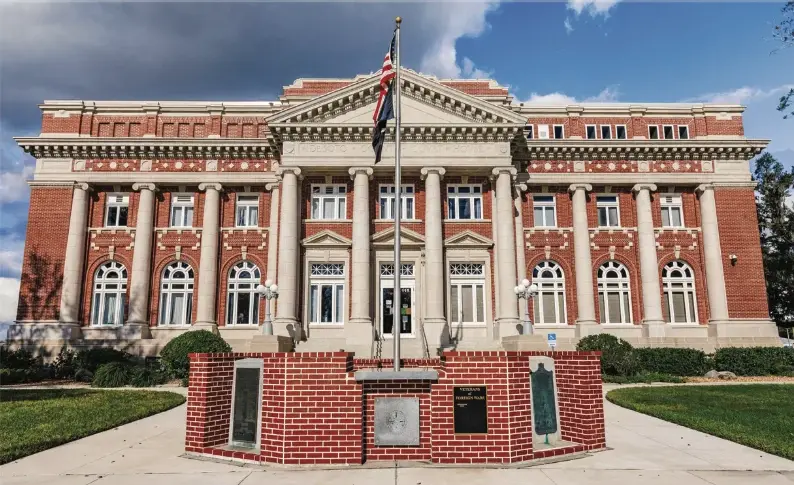
The DeSoto County Courthouse is the most important building in Arcadia's historic district and is listed on the National Register of Historic Places, making authentic character restoration the leading concern on this project. The redbrick courthouse is a significant example of American monumental classical design and ornamentation, adapted to the traditional setting of a small-town Southern courthouse square. True to its intended function and to the period of its construction, it combines elements of Greek and Roman Classicism to create a dignified but welcoming presence.
After surviving more than a century of hot, humid summers and occasional hurricanes, the structure was showing its age. But as the focal point of the town of Arcadia and DeSoto County, it was well worth preserving. Graciano's team painstakingly executed a period-sensitive restoration program -- on budget and on time -- within a six-month period, while day-to-day courthouse business continued without interruption.
Scope of Work
Services Performed
- Individual historic brick replacement
- Brick facade rebuild and repointing
- Repointing of limestone masonry joints
- Repointing of terra cotta elements
- Terra cotta repair
- Stone and terra cotta facade pinning
- Stone patching
- Lintel replacement
- Structural steel repair and replacement
- Waterproofing of terra cotta cornices
- Waterproofing of main roof
- Masonry surface rehabilitation
- Water cleaning
- Sealants
- Add handrail extensions
- Lightning protection
Brick and Limestone Restoration
The courthouse's redbrick exterior had suffered from decades of Florida's weather -- high heat, humidity, driving rain, and the occasional tropical storm. Failed mortar joints, spalled brickwork, and cracked limestone trim required systematic repair. Graciano performed extensive repointing of brick and limestone joints, matching mortar color and composition to the existing joints to preserve the visual integrity of the historic facades. Individual historic bricks were replaced in kind wherever deterioration had progressed beyond repair, sourcing units matched to the original in size, color, and texture.
Terra Cotta Cornice Restoration
The courthouse's ornate terra cotta cornices and classical ornamentation required particular care. Terra cotta units were assessed for condition, and deteriorated pieces were repaired using patching materials matched to the original glaze and profile. Failed joints were repointed. To prevent future water infiltration, which is a primary cause of terra cotta spalling and freeze-thaw damage even in Florida's mild winters, all cornices received waterproofing treatment following restoration of the masonry joints and units. Stone and terra cotta facade pinning stabilized elements where structural movement had begun.
Historic Sensitivity
Because the courthouse is listed on the National Register of Historic Places, all restoration methods and materials were selected for compatibility with the Secretary of the Interior's Standards for the Treatment of Historic Properties. The Graciano team coordinated material selections to match original construction and ensure the finished work would be invisible to the untrained eye -- preserving the building's period character while greatly extending its service life.
Awards
About Graciano Corporation
Founded in 1916, Graciano Corporation is one of the oldest and most experienced masonry and concrete restoration firms in the United States. With offices in Pittsburgh, PA, New York, NY, and Florida, Graciano performs approximately 90% of all work in-house with its own skilled journeymen. The company is a WBENC-certified Woman Business Enterprise and follows the Secretary of the Interior's Standards for Historic Preservation on all landmark work.