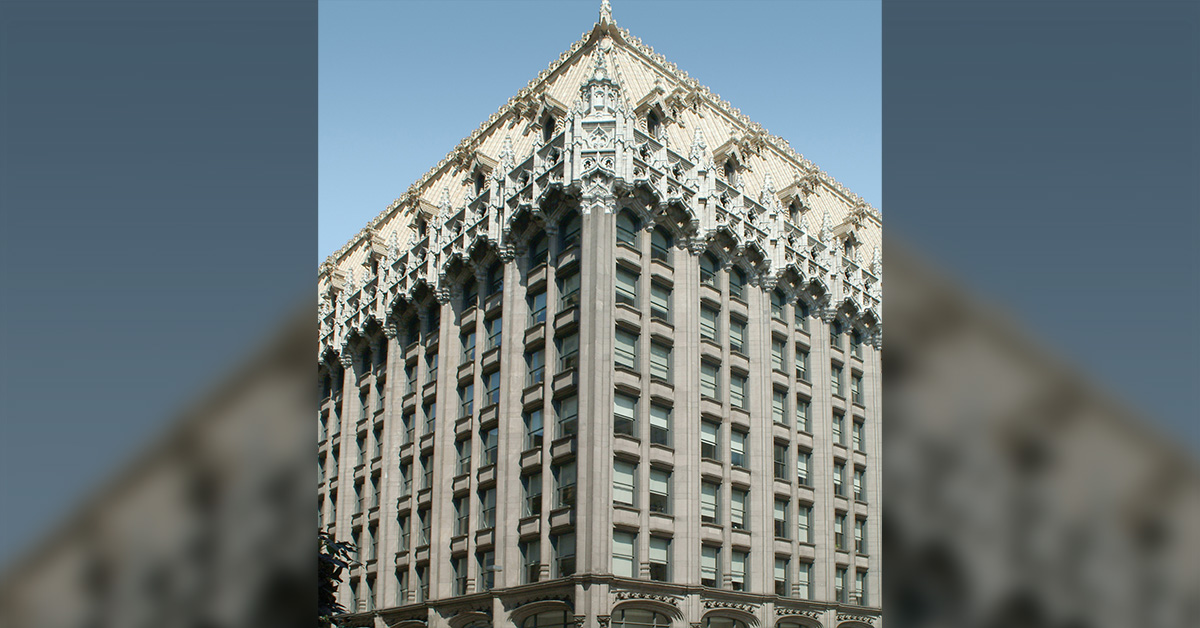
Two Mellon Center is one of Pittsburgh's most architecturally distinctive downtown buildings. The Flemish-Gothic limestone structure occupies a full city block and features a 65-foot-high mansard roof pitched at 17 degrees, 38 dormers across three tiers, two towers, balustrades, and four terra cotta eagles at the roofline corners. Constructed in 1919, the building served as Mellon Financial's corporate headquarters for decades.
Despite its prominence and architectural ambition, Two Mellon Center had suffered from chronic water infiltration from the time of its original construction. Moisture penetrating through the mansard roof, failed waterproofing systems, and deteriorated masonry had compromised portions of the building's interior and created ongoing maintenance challenges that required a comprehensive, multi-year restoration program to address definitively.
"The 10th floor had become completely unusable due to leakage. Now it is finally being preserved."
Bernard Koblinsky, Assistant Vice President, Mellon FinancialScope of Work
Services Performed
- Main roof and mansard roof repairs and reconstruction
- Water diversion system design and installation
- Exterior waterproofing across the building envelope
- Terra cotta component replacement using glass fiber reinforced concrete (GFRC)
- Steel structure repairs including angles, pins, channels, and dormer support sections
- Specialized rigging and man-basket systems for the steeply pitched mansard
- Unit stone replacement and stonework throughout the exterior
- Repointing of masonry joints
- Pressure washing and masonry cleaning
- Chemical cleaning and protective coatings
- Flashings renewal
- Parapet reconstruction
- Brick facade rebuilding where required
Mansard Roof Challenges
The 65-foot mansard roof pitched at 17 degrees presented significant access and structural challenges. Work on a steeply pitched mansard at this scale requires specialized rigging -- conventional scaffolding cannot safely anchor on a surface at that angle. Graciano deployed man-basket systems and custom rigging to give craftsmen safe, stable working positions on the roof surface while managing material lifts and debris removal at the same time.
The 38 dormers across three tiers added complexity to the waterproofing program. Each dormer represents a penetration through the roof plane, a critical interface between roof material and exterior wall cladding, and a potential water entry point. Graciano's scope addressed each dormer as a discrete waterproofing assembly in addition to the continuous mansard surface treatment.
Terra Cotta Replacement with GFRC
The four terra cotta eagles at the roofline corners and other decorative terra cotta elements required replacement rather than repair. Where original terra cotta units could not be salvaged, Graciano specified glass fiber reinforced concrete (GFRC) as the replacement material. GFRC allows complex ornamental profiles to be reproduced with high dimensional accuracy, and its mechanical properties are well-suited to exterior applications where freeze-thaw cycling and structural loading are factors.
A Long-Term Restoration Program
The five-year duration of the Two Mellon Center project reflects the scale and complexity of restoring a building that occupies a full city block and presents multiple interacting failure modes. Chronic water infiltration at a building of this type cannot be resolved with a single repair sequence; it requires systematic investigation, phased remediation, and careful sequencing to ensure that each element of the waterproofing system is integrated with the next. Graciano's role as general contractor allowed the firm to coordinate this sequencing across the full scope of work over the project's multi-year timeline.
About Graciano Corporation
Founded in 1916, Graciano Corporation is one of the oldest and most experienced masonry and concrete restoration firms in the United States. Headquartered in Pittsburgh, PA, with additional offices in New York, NY, and Florida, Graciano performs approximately 90% of all work in-house with its own skilled journeymen. The company is a WBENC-certified Woman Business Enterprise and has built its reputation on demanding commercial and historic restoration projects across the eastern United States.