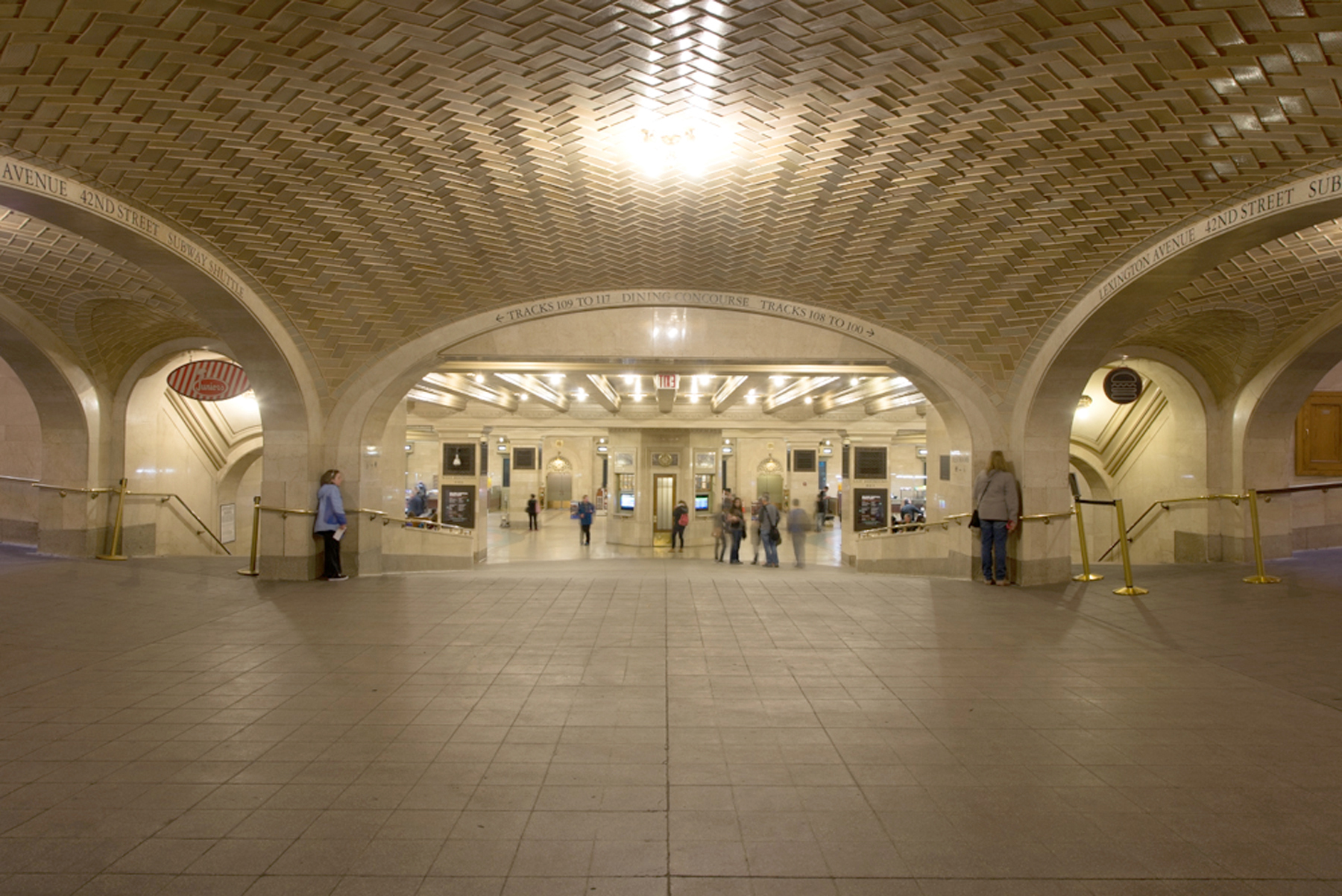
The Whispering Gallery at Grand Central Terminal is one of the most distinctive interior spaces in New York City. Located beneath the Oyster Bar and Restaurant on the lower concourse, the vaulted hall's distinctive acoustics -- a whisper spoken into one corner can be heard clearly in the diagonally opposite corner -- have made it a landmark attraction since the terminal's 1913 opening. The vaulting is the work of Rafael Guastavino y Esposito, the Spanish architect whose interlocking tile system defined some of the most technically sophisticated masonry in American history.
By 2012, the original Guastavino terra cotta tiles required restoration to address deterioration accumulated over nearly a century of continuous use. Graciano Corporation performed the restoration work, drawing on its extensive expertise in Guastavino tile systems at major New York City landmarks.
The Guastavino System
Guastavino vaults are constructed using thin terra cotta tiles laid in multiple self-supporting laminated courses, bound with Portland cement mortar. The system is remarkable for its structural efficiency: the vaults carry their loads through compression in the tile mass rather than through conventional arch supports, allowing elegant, thin-shell forms that would be difficult to achieve with conventional masonry. The raised mortar joints that characterize the Guastavino finish are technically demanding to match in restoration because they require precise tooling to reproduce the original profile.
Graciano has worked on Guastavino systems throughout New York City, including the Oyster Bar itself, the Queensboro Bridge Bridgemarket, and other landmark structures. This depth of specific experience with the Guastavino system informed every decision at the Whispering Gallery.
Scope of Work
Services Performed
- Replacement of more than 1,000 original Guastavino terra cotta tiles
- Repair of tile damage throughout the vaulted ceiling
- Repointing of more than 1,000 technically challenging raised mortar joints
- Water cleaning and surface rehabilitation of tile surfaces
- Stonework and stone patching at related surfaces
- Chemical and hand cleaning methods
- Paint removal where required
Working in an Active Transit Landmark
Grand Central Terminal is one of the busiest transit hubs in the world, welcoming approximately 750,000 visitors daily. Restoration of the Whispering Gallery required coordinating access and work schedules around the terminal's operating hours and protecting the public below the work area throughout the three-month engagement. Graciano's experience with occupied historic buildings -- from performing arts venues to active civic centers -- prepared the team for this level of operational constraint.
Tile Matching and Historical Accuracy
Replacing original Guastavino tiles requires sourcing or fabricating units that match the original in composition, color, texture, and dimensional profile. Off-specification replacements are immediately visible in the field and introduce inconsistencies in the compressive behavior of the vault system. Graciano's tile replacement program at the Whispering Gallery maintained dimensional and material consistency with the surviving 1913 fabric.
The raised mortar joint repointing was particularly demanding: the original profile must be precisely reproduced by hand, and the mortar must be formulated to match in color and compressive strength without exceeding the strength of the tile units themselves. These requirements reflect the same technical standards that Graciano applies to all Guastavino restoration work.
About Graciano Corporation
Founded in 1916, Graciano Corporation is one of the oldest and most experienced masonry and concrete restoration firms in the United States. Headquartered in Pittsburgh, PA, with additional offices in New York, NY, and Florida, Graciano performs approximately 90% of all work in-house with its own skilled journeymen. The company is a WBENC-certified Woman Business Enterprise and holds particular depth of expertise in Guastavino tile systems, terra cotta restoration, and the landmark-scale projects that define New York's built heritage.